Wednesday, October 31, 2018

Film Viewing Practice Essay


Word Count: 675
Throughout the movie Agent Carter from Marvel, there are noticeable aspects of editing, music, camera shots/angles, and mise-en-scène. Each of these film components contribute to the meaning of the plot as a whole, and ultimately help the filmmaker enhance the storyline.
To start, the film uses the editing technique of parallelism which highlights the differences and similarities between two scenes. In this case, viewers see alternating shots between Peggy and Steve as Peggy sits in an office and Steve is flying an aircraft that is in the line of danger. The similarities between these shots is the panic that is evident in the subjects’ faces, as well as the dramatic orchestra music that follows through with each shot. As for differences, Peggy is in an evidently less threatening environment whereas Steve appears to have his life on the line in the aircraft. This technique enhances the film because it shows how interconnected the characters are emotionally despite being physically separated. Also, leitmotif, which is a shot with a recurring theme, can be seen in the Marvel introduction sequence. This sequence is shown at the start of all Marvel movies, and the sequence sets viewers up with an expectation of the movie through general Marvel themes.
Sound is another technique that is employed in this film, where the film starts off using nonsimultaneous sound. Nonsimultaneous sound is sound in a film that takes place at a different point than in the specific scene it is used in. Non simultaneous sound occurs in the beginning of this film through sound of Steve and Peggy frantically radioing to each other during the flip scene of the Marvel introduction. This sound is important because it sets the film up for a sense of urgency and panic by making the very first scene inclusive of such a panic. Also, non-diegetic sound is used in the beginning of the film through emotional violin music. This sound was added in after the film, and it adds a sense of emotion and pain that the characters are feeling upon Steve’s situation because violin music is incorporated with sadness. Finally, a sound bridge is used to connect the scene from the fighter aircraft to the establishing shot of the city. This carrying of sound helps to relate the scenes which shows how the problems from the original shot are carrying on through time.
Moreover, certain camera shots and angles were used in the film to convey the meaning of the story better. For example, an establishing shot, which is a shot used to set the scene, is used when a wide view of the city is first shown. This view helps viewers to recognize that the setting is NYC, which is a bustling city full of life and action, where intense action will eventually occur for the characters. Also, an over the shoulder shot is used as the two men in Peggy’s case speak to her and as Peggy speaks back to them. This use of over the shoulder in two different ways helps to put the two parties on a more equal playing field, as Peggy is not any weaker than the men.
Finally, aspects of mise-en-scène can also be viewed in this movie. For example, low key lighting with darkness and shadowing is used in the office. This use of lighting develops an understanding that the workers there handle “dark” business, and that for Peggy, this is not necessarily a happy, welcoming place. At one point, however, Peggy is discussing her future with her boss, where the lighting appears of a higher key (ex: brighter lighting with less shadows) which symbolizes hope and joy for her future. Also, in regard to staging, there is a use of blocking in which all of Peggy’s male coworkers are placed near each other as she stands alone which shows how for this time period, men were considered more dominant.
Ultimately, the filmmaker of Agent Carter employed aspects of editing, sound, camera shots/angles, and mise-en-scène to help convey the emotions and meaning the story.

Saturday, October 20, 2018

Mise en Scène - Legally Blonde Movie

I chose to watch the movie "Legally Blonde" in an attempt to analyze aspects of mise en scène, which include costume, setting, staging, and lighting.

1.) Costume: The use of costume both in the beginning and end of the film help to convey the story of the transformation of Elle from a silly sorority member to a sophisticated lawyer.  Elle begins by wearing wildly patterned, bright clothes such as crop tops, tight dresses, and short shorts before she becomes a lawyer. However, after Elle becomes a lawyer, she begins to dress in a more reserved fashion by wearing business outfits such as cardigans, professional pencil skirts, and collared shirts. The outfits still have tinges of pink and purple, which are Elle's favorite colors, which shows how Elle had a transformation, but that she also maintained her sense of self throughout the process.

2.) Setting: The set designers from this movie chose to use setting in a similar way to how costume was used. The beginning of the movie takes places in a bustling sorority house, with bright, colorful furniture and silly decorations. The house has many rooms filled with girls, games, and partying. At the end of the movie, however, when Elle becomes a lawyer and attends Harvard, the setting completely changes. Elle is in and out of dark and serious court rooms as well as classrooms, and is surrounded by serious lawyers and students alike. These two settings visually show Elle's two different mindsets throughout the movie, which are mindsets first of partying, and then of seriousness.

3.) Staging and acting: In terms of staging and acting, Reese Witherspoon (the actress who plays Elle) used method acting. At the beginning of the film, Reese truly personifies Elle by raising her voice in a high pitched tone, wearing glitzy clothing and accessories, and using silly hand and body movements. All of this acting helps to create the initial portrayal of Elle, which is a goofy and immature character. Also, the use of blocking through character placement helps to show Elle's transformation throughout the movie. For example, when Elle is taking her LSAT test to get into law school, she is placed right in the middle of hundreds of other potential law students which shows how, in that moment, she is lost amidst others and does not know where she stands quite yet. However, later on once Elle is in law school, she sits right in the front of the class, and thus in front of her classmates. This placement shows how Elle is truly a go-getter and that she is willing to work hard to achieve her goals of coming in "first".

4.) Lighting: When Elle is still caught up in her lifestyle as a sorority girl, high-key lighting is used frequently. Whether Elle is at the well lit pool or at a fancy boutique, Elle is casted in bright, low shadow lighting. This use of lighting helps to show how, at that point in her life, Elle was nearly immune to the struggles of the outside world as her concerns were typically immature and not serious, thus her life was bright and bubbly. However, after Elle begins attending Harvard Law School and entering the court rooms, there is low-key lighting that features darkness and shadows. This use of lighting is important in showing how Elle's life has become increasingly difficult and serious, as darker colors and lighting are far more serious than happier, lighter colors and lights. Again, this use of lighting helps to visually show Elle's transition into a more mature individual through her education.

Friday, October 12, 2018

Five Editing Techniques - Sound


Link to "Five Editing Techniques With Sound": https://www.youtube.com/watch?v=IuCh3oDa_mU

1.) The first clip (symbolism) included post synchronization dubbing, which is a form of non-digetic sound. Post synchronization dubbing is sound that is added to a scene after the filming was done, meaning that the sound is not natural to the scene. In this case, the clip included non-digetic sounds of birds chirping that were not actually present in the clip naturally, as a means of making the scene more authentic and "nature" based, which was the goal of the clip. This increased authenticity of the clip help to give viewers a feeling of just how beautiful and important the environment is, shown by the life provided by the birds chirping sound.

2.) The second clip (contrast) included a voice-over, which is non-digetic sound. A voice-over is when someone is speaking in a clip, but the speaker is not present in the clip. In this case, the clip shows girls writing and typing to contrast the two forms of conveying information, where a voice-over is present and the girls are discussing the stress of getting their work done. The girls are not actually speaking in the clip, but rather the editing included the voices that were recorded separately from the clip and then placed in the scene to make it seem like there was speaking happening. This use of voice-over helps to give viewers a sense of urgency that the girls are facing as they struggle to submit an assignment, as the voice-over includes the girls with a clear sense of panic in their voices.

3.) The third clip (parallelism) included music, which is a form of non-digetic sound. Music is simply a use of theme music, where the music was not originally in the clip, but rather added in later through editing. In this case, the girls feet walking are accompanied by music with lyrics of "I would walk 500 miles, and I would walk 500 more" to help convey the idea that the girls are walking on and on in a variety of paralleling scenes. This use of music, specifically through the lyrics, help to show viewers just how far the girls are walking, evoking a sense of length and time for the viewer.

4.) The fourth clip (simultaneity) included digetic sound, which is sound that can be originally found in the clip. In this case, the original clip included a girl talking about a murder, accompanied by a clip with a murder. The original sounds of the girl talking and the sounds of the murder (ex: falling to the ground loudly) were natural to the shot, thus they are digetic sound. This digetic sound is important as it helps viewers understand the severity of the murder by getting context.

5.) The fifth clip (leitmotif) included non-digetic sound through music. Music is simply a use of theme music, where the music was not originally in the clip, but rather added in later through editing. In this case, the scary and loud music was added as the time went on to give viewers a sense of panic and urgency as the due time for the assignment came nearer.

Thursday, September 27, 2018

Five Editing Techniques in the Movie "Lion"


Five Editing Techniques Found in "Lion"
Director: Garth Davis


Symbolism: A symbolism shot moves from one scene to the next where there is a symbolic connection between the shots. In this case, the symbolic transition lies between the bright sun which changes to the dark tunnel. The boys are travelling toward, what would soon become the poor fate of Saroo. Thus, the symbolism of the sun turning to darkness upon the boys' journey represents the darkness and pain that would come upon Saroo's future disappearance.


Parallelism: A parallelism shot brings two different scenes together by highlighting both their differences and the similarities between them. In this case, the parallelism comes between a shot of the boy screaming and the train, where both of the subjects are expressing sound through the train horn. The shots are paralleled through the horn, showing the urgency of the trains approach and the boy's urgency as he realizes he is completely alone, but separated as viewers see a shot of the boy and the train, showing their differences and the scope of the problem the boy is stuck in.


Contrast: A contrast shot includes two differing shots to make the difference between them clearer. In this case, the contrast is between one shot of the young boy, surrounded by butterflies and smiling, where the other shot is of his older brother, much higher up and less entertained. This contrast highlights their age difference due to the innocence the younger brother feels, shown through his joy at the butterflies while his brother, less innocent to the trials of the world stands higher, not surrounded by butterflies or smiling.


Leitmotif: A leitmotif shot includes a recurring theme, where in this case the theme was a repeated scene of the boy approaching strangers, asking each time for "Genestalay". The repetition of "Genestalay" and repetition of asking helps to convey helplessness and the ultimate fate of Saroo, as each time he approaches someone new (leitmotif), Saroo has the same failed outcome.


Simultaneity: A simultaneity shot uses two scenes that occur at the same period of time in an attempt to build suspense. In this case, viewers see the parents of the man listening to his voicemail at the same time as he is far away from home, independent. This simultaneity builds up feelings as it shows how his parents still feel love and concern for him while he is alone, so far away.

Thursday, September 20, 2018

Five Editing Techniques

Link to "5 Editing Shots" video: https://www.youtube.com/watch?v=M89KQPmdd0o

  1. Symbolism: The first shot that Erin and I made was the symbolism shot. A symbolism shot moves from one scene to the next where there is a symbolic connection between the shots. In the case of this video, the two shots film both a reusable water bottle and a tree coming up from the grassy ground. This is symbolic of the importance of recycling through reusable water bottles, as recycling allows for the Earth to flourish and grow without as much trash.
  2. Contrast: The second shot that Erin and I made was the contrast shot. A contrast shot includes two differing shots to make the difference between them clearer. In this case, the separate shots highlight the difference between typing a piece of work and writing a piece of work. The close-ups of the typing and writing allow viewers to see how, between the two types of conveying information, differences in appearance, sound, and time spent writing are present.
  3. Parallelism: The third shot that Erin and I made was the parallelism shot. A parallelism shot brings two different scenes together by highlighting both their differences and the similarities between them. In this case, Erin and I are walking on two different green surfaces which is a similarity between them, however one is artificial and one is natural. Thus, viewers can see the comparison and contrast between the two scenes that both bring a sense of uniqueness and commonality. 
  4. Simultaneity: The fourth shot that Erin and I made was the simultaneity shot. A simultaneity shot uses two scenes that occur at the same period of time in an attempt to build suspense. In this case, Erin and I used a scene of a subject being murdered while a news broadcast was reporting about a murderer on the loose. This sense of panic, fear, and the unknown drives up suspense as we see that not only has a murder occurred, but the murderer is still on the loose and killing others as the events occurred simultaneously. 
  5. Leitmotif: The fifth and final shot that Erin and I made was the leitmotif shot. A leitmotif shot includes a recurring theme, where in this case the theme was a musical concept. The clip encompassed the idea that stress is high as the time an assignment is due approaches, thus the use of gradually yet steadily occurring suspense music helps to create the sense of panic felt by a student.


Sunday, September 9, 2018

Week 4 - TV Show Angles


Review of Camera Angles from Season One, Episode One of 3% (2018)
Producer: Pedro Aguilera 

         I chose to do my camera angle assignment on this television show based on the understanding that this show takes place in a future society, thus I hoped to see interesting camera angles used in an attempt to convey the way society works for this time period. Luckily, I was not disappointed by this, as there were many different camera angles applied in this show that showed the viewer how this society functioned, which in turn created emotions for the viewer on the new, foreign world.

The first camera angle that I chose was a full shot, showing the leader of "The Process" standing among a large screen that shows him how the participants of The Process are getting along in their testing. Full shots show the subject's whole body, and in this scene it is very symbolic that the leader's full body is so minute compared to the large screen, showing how his world has become consumed by The Process and how for many in the society, The Process is a very big deal. Thus, this scene conveys a sense of severity for viewers in terms of The Process for the members of society.
     This is both an over-the-shoulder shot and a high angle shot. A high angle shot films subjects from high above, where in this case the subjects are being spoken to by the leader of The Process. Thus, compared to the largeness of the leader developed through the over-the-shoulder shot, the subjects appear very small as they are so far away. The leader ultimately has control over the destiny of these individuals, thus his largeness and highness compared to the small subjects gives him a sense of superiority and control to viewers, whereas the subjects appear vulnerable and insignificant as they have little to no control over their lives.
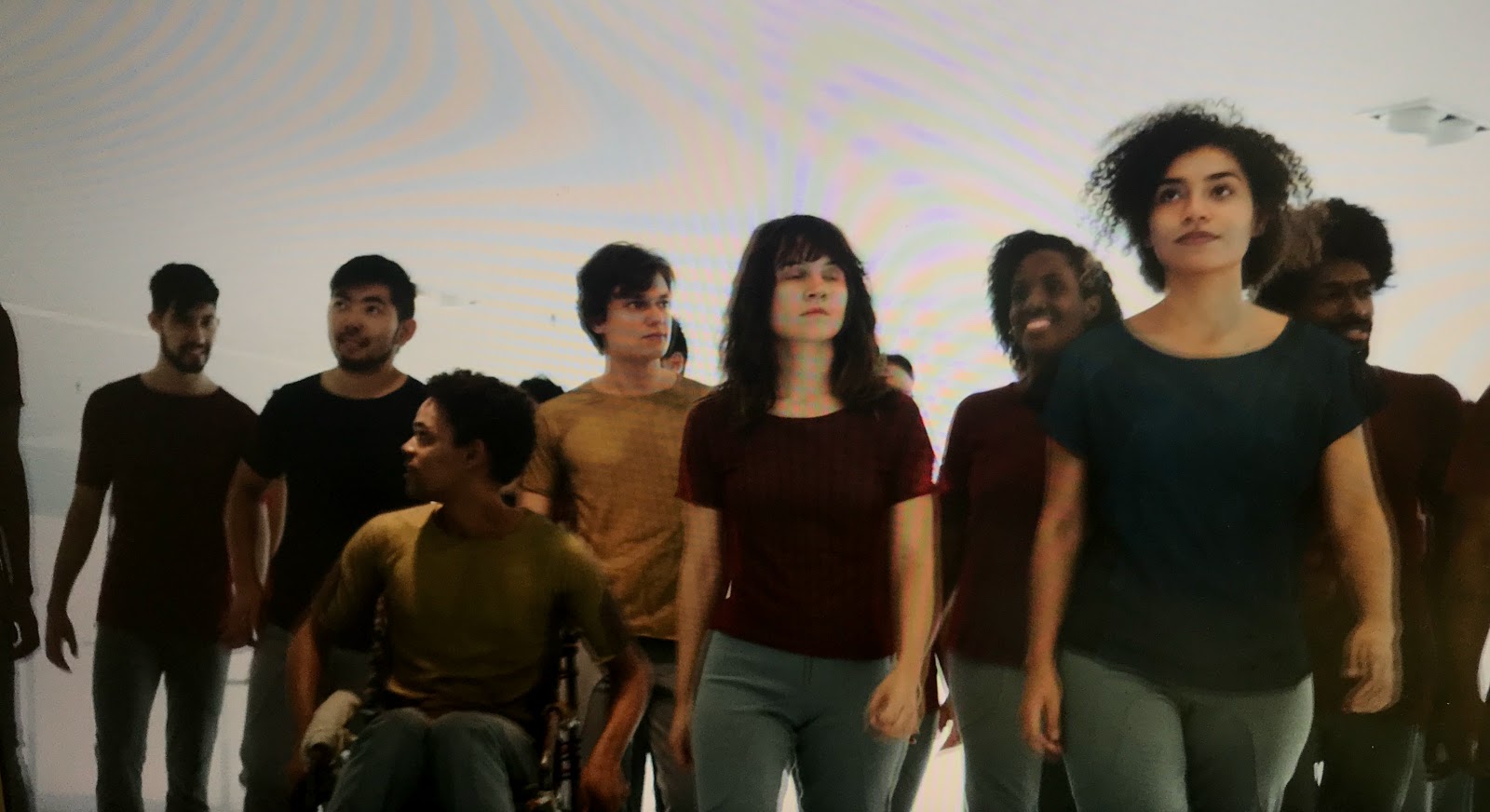
This is a cameo shot, meaning that the scene was shot using a neutral background. In this case, the background is pure white, where it should be recognized that white symbolizes purity, and in the case of these individuals, they are on their way to begin intense training to see if they qualify to be in the 3%. This training will likely be psychologically and physically draining, and many will be rejected from the opportunity to join the 3%. Thus, through seeing the individuals pass through the white corridor on their way to begin The Process, it is symbolic of the current state of their innocence which may soon be ripped from them.
This is a two-shot, meaning that it is a close shot for two people. In this case, the woman is confronting the man about him cheating the system of The Process. Due to this shot showing the two on an equal level, viewers see the woman's attempts to become mentally level with the man after he tried to show dominance in the group of people. Thus, the comparison of the two in size helps show the woman's strength and the man's submission to her, which helps us see into the characters more.