Thursday, September 27, 2018

Five Editing Techniques in the Movie "Lion"


Five Editing Techniques Found in "Lion"
Director: Garth Davis


Symbolism: A symbolism shot moves from one scene to the next where there is a symbolic connection between the shots. In this case, the symbolic transition lies between the bright sun which changes to the dark tunnel. The boys are travelling toward, what would soon become the poor fate of Saroo. Thus, the symbolism of the sun turning to darkness upon the boys' journey represents the darkness and pain that would come upon Saroo's future disappearance.


Parallelism: A parallelism shot brings two different scenes together by highlighting both their differences and the similarities between them. In this case, the parallelism comes between a shot of the boy screaming and the train, where both of the subjects are expressing sound through the train horn. The shots are paralleled through the horn, showing the urgency of the trains approach and the boy's urgency as he realizes he is completely alone, but separated as viewers see a shot of the boy and the train, showing their differences and the scope of the problem the boy is stuck in.


Contrast: A contrast shot includes two differing shots to make the difference between them clearer. In this case, the contrast is between one shot of the young boy, surrounded by butterflies and smiling, where the other shot is of his older brother, much higher up and less entertained. This contrast highlights their age difference due to the innocence the younger brother feels, shown through his joy at the butterflies while his brother, less innocent to the trials of the world stands higher, not surrounded by butterflies or smiling.


Leitmotif: A leitmotif shot includes a recurring theme, where in this case the theme was a repeated scene of the boy approaching strangers, asking each time for "Genestalay". The repetition of "Genestalay" and repetition of asking helps to convey helplessness and the ultimate fate of Saroo, as each time he approaches someone new (leitmotif), Saroo has the same failed outcome.


Simultaneity: A simultaneity shot uses two scenes that occur at the same period of time in an attempt to build suspense. In this case, viewers see the parents of the man listening to his voicemail at the same time as he is far away from home, independent. This simultaneity builds up feelings as it shows how his parents still feel love and concern for him while he is alone, so far away.

Thursday, September 20, 2018

Five Editing Techniques

Link to "5 Editing Shots" video: https://www.youtube.com/watch?v=M89KQPmdd0o

  1. Symbolism: The first shot that Erin and I made was the symbolism shot. A symbolism shot moves from one scene to the next where there is a symbolic connection between the shots. In the case of this video, the two shots film both a reusable water bottle and a tree coming up from the grassy ground. This is symbolic of the importance of recycling through reusable water bottles, as recycling allows for the Earth to flourish and grow without as much trash.
  2. Contrast: The second shot that Erin and I made was the contrast shot. A contrast shot includes two differing shots to make the difference between them clearer. In this case, the separate shots highlight the difference between typing a piece of work and writing a piece of work. The close-ups of the typing and writing allow viewers to see how, between the two types of conveying information, differences in appearance, sound, and time spent writing are present.
  3. Parallelism: The third shot that Erin and I made was the parallelism shot. A parallelism shot brings two different scenes together by highlighting both their differences and the similarities between them. In this case, Erin and I are walking on two different green surfaces which is a similarity between them, however one is artificial and one is natural. Thus, viewers can see the comparison and contrast between the two scenes that both bring a sense of uniqueness and commonality. 
  4. Simultaneity: The fourth shot that Erin and I made was the simultaneity shot. A simultaneity shot uses two scenes that occur at the same period of time in an attempt to build suspense. In this case, Erin and I used a scene of a subject being murdered while a news broadcast was reporting about a murderer on the loose. This sense of panic, fear, and the unknown drives up suspense as we see that not only has a murder occurred, but the murderer is still on the loose and killing others as the events occurred simultaneously. 
  5. Leitmotif: The fifth and final shot that Erin and I made was the leitmotif shot. A leitmotif shot includes a recurring theme, where in this case the theme was a musical concept. The clip encompassed the idea that stress is high as the time an assignment is due approaches, thus the use of gradually yet steadily occurring suspense music helps to create the sense of panic felt by a student.


Sunday, September 9, 2018

Week 4 - TV Show Angles


Review of Camera Angles from Season One, Episode One of 3% (2018)
Producer: Pedro Aguilera 

         I chose to do my camera angle assignment on this television show based on the understanding that this show takes place in a future society, thus I hoped to see interesting camera angles used in an attempt to convey the way society works for this time period. Luckily, I was not disappointed by this, as there were many different camera angles applied in this show that showed the viewer how this society functioned, which in turn created emotions for the viewer on the new, foreign world.

The first camera angle that I chose was a full shot, showing the leader of "The Process" standing among a large screen that shows him how the participants of The Process are getting along in their testing. Full shots show the subject's whole body, and in this scene it is very symbolic that the leader's full body is so minute compared to the large screen, showing how his world has become consumed by The Process and how for many in the society, The Process is a very big deal. Thus, this scene conveys a sense of severity for viewers in terms of The Process for the members of society.
     This is both an over-the-shoulder shot and a high angle shot. A high angle shot films subjects from high above, where in this case the subjects are being spoken to by the leader of The Process. Thus, compared to the largeness of the leader developed through the over-the-shoulder shot, the subjects appear very small as they are so far away. The leader ultimately has control over the destiny of these individuals, thus his largeness and highness compared to the small subjects gives him a sense of superiority and control to viewers, whereas the subjects appear vulnerable and insignificant as they have little to no control over their lives.
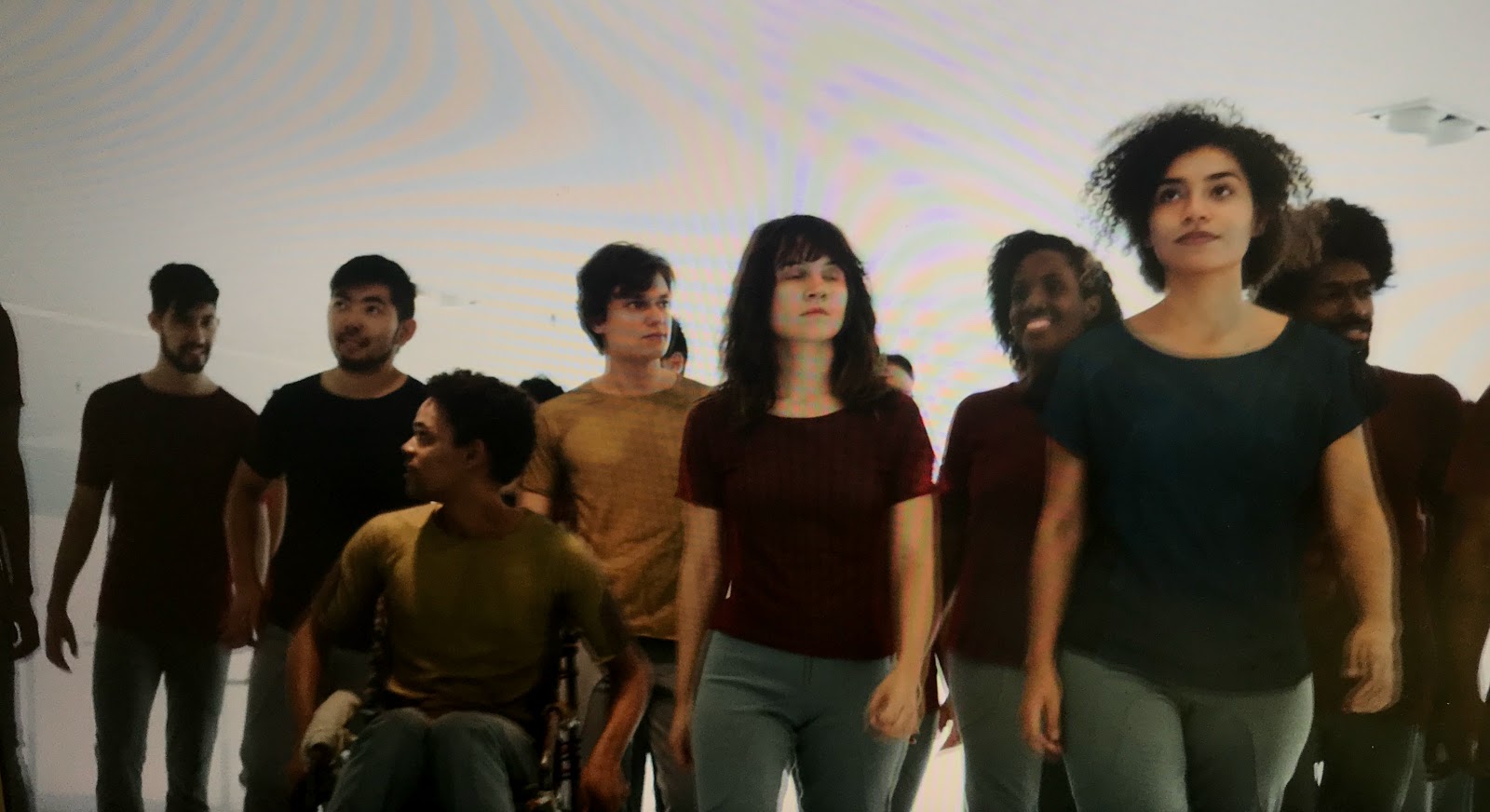
This is a cameo shot, meaning that the scene was shot using a neutral background. In this case, the background is pure white, where it should be recognized that white symbolizes purity, and in the case of these individuals, they are on their way to begin intense training to see if they qualify to be in the 3%. This training will likely be psychologically and physically draining, and many will be rejected from the opportunity to join the 3%. Thus, through seeing the individuals pass through the white corridor on their way to begin The Process, it is symbolic of the current state of their innocence which may soon be ripped from them.
This is a two-shot, meaning that it is a close shot for two people. In this case, the woman is confronting the man about him cheating the system of The Process. Due to this shot showing the two on an equal level, viewers see the woman's attempts to become mentally level with the man after he tried to show dominance in the group of people. Thus, the comparison of the two in size helps show the woman's strength and the man's submission to her, which helps us see into the characters more.


Thursday, August 30, 2018

Assignment Week 3 - Classmate Commentary

   For this assignment, I commented on two blog posts that were composed by my classmates regarding four out of twelve of their shots that impacted me emotionally. I chose to comment on Josh's and Laura's blogs.
   On Josh's blog post, I chose to comment on the extreme close-up shot, the eye level shot, the flash shot, and the POV shot.
1.) I first enjoyed the extreme close-up shot, which, in this case was of a subject's eye up close. According to filmmakingpro.com, close-up shots "help you feel whatever they [the subject] are feeling". I certainly feel that this was applicable to this shot, as they say that the "eyes are the windows to the soul", thus the clear, close video of the eye helped me to see into the subject and their emotions.
2.) Furthermore, I enjoyed the eye level shot which captured the subject at eye level, saying "hi" and smiling. According to filmmakingpro.com, eye level shots make the audience feel like "they are included in the scene". I truly felt that this was true, as the eye level shot gives a feeling of staring directly at the subject as though you were talking to them, which makes you, as the viewer, feel included and connected with the subject.
3.) Moreover, I enjoyed the flash shot, which included a relatively neutral background that is suddenly disturbed by a jumping subject. As a viewer, I was not expecting the neutral view to be obstructed as there was no sign of the subject before the jump, thus I was left quite startled and frightened!
4.) Finally, I enjoyed the POV shot which included the director's hand causing the subject to go flying. According to filmmakingpro.com, POV shots "make you feel like you were placed inside the person's eyes", which is supposed to make you "feel creepy". This can certainly be said for this clip, as it felt like I, as the viewer, was sending the subject flying because my sight was the exact sight level from the director who was controlling the actions. However, in reality I did nothing!

   On Laura's blog, I commented on the choker shot, the dolly shot, the extreme long shot, and the high angle shot.
1.) I first enjoyed the choker shot, which was a close up, all encompassing shot of a subject who appears very confused. Due to the closeness and use of spacing to only show the subject, I truly got to see how the subject was feeling in facial language such as eye movements and mouth movements. Thus, I was able to feel confusion as the subject's clarity in emotion due to the shot was able to relay to me.
2.) Next, I enjoyed the dolly shot which was filmed as the director was heading up a bridge. I enjoyed this shot, because it mimicked the feeling of walking up a bridge myself due to the moving action as if the camera were moving up the bridge on a dolly.
3.) Furthermore, I enjoyed the extreme long shot which showed a large view of a sunset from a high point. According to filmmakingpro.com, extreme long shots give a feeling of being "less significant compared to the world around them". In this case, the intensity and broadness of the view is consuming for a viewer, showing how big the world really is. Thus, watching this did give me a feeling of inferiority compared to the world, yet the beauty of the shot due to the time of day and establishment of the shot on a nice body of water was enjoyable.
4.) Finally, I enjoyed the high angle shot which filmed a subject dancing from very high above the subject. According to filmmakingpro.com, high angle shots "make you feel like the character is less significant", which is completely true. The subject is so small in this clip that one cannot help but feel as though the subject is inferior and vulnerable.

Thursday, August 23, 2018

Assignment Week 2-Different Shots

This is a "close-up shot", showing a subject's hands on a close level while using a cell phone. This shot was relatively easy to take, however, due to the closeness of the shot, I had to ensure that the camera was focused to make the clip clear.


This is a "reaction shot", characterized by the fact that the subject is "reacting to something off camera", where in this case the subject appears to be startled by something. There were no complications in making this shot other than ensuring that the camera was still and that the timing was right for the shock.


This is a "tilt shot", characterized by the fact that the camera is moving "up a vertical axis". This shot was simple to make, but the shot just took a long time to create as I wanted to clearly show the entire subject without going too quick.


This is an "over-the-shoulder" shot, characterized by the fact that viewers are able to see a "character's point of view" that includes "part of that character's shoulder". This shot was slightly trickier to make than others, as I had to maintain a steady shot so as to show the shoulder and focus on the content of the cell phone at the same time.


This is a "high angle shot" as characterized by the fact that the subject is "filmed from a high above". This filming process was tricky as I had to stand on a chair to film the subject from the high angle.


This is a "head- on shot" characterized by the fact that the action is coming "directly at the camera". While filming this shot, I just had to perfect the timing so that the subject would run toward the camera right when I began recording as the action was so fast.


This is a "full shot", characterized by the fact that I "captured the subject's entire body" in the clip. While making this shot, I had to ensure that my subject knew the boundaries of the camera so that I did not have to move the camera while she was moving.


This is a "follow shot", characterized by the fact that the "camera follows the subject". Due to the fact that I was walking in this, I had to ensure that the camera was steady throughout which was a challenging task as walking can get bumpy.


This is a "flash shot", characterized by the fact that there is a "shock effect". The only challenging thing about this shot was ensuring that the camera was steady so as not to give away the subject waiting below to jump.


This is a "cameo shot" characterized by the fact that the subject is being "filmed against a neutral background". This shot was easy to make as the only thing I needed to do was find a neutral background and film my subject.


This is a "close shot" characterized by the fact that the subject is filmed from "the top of the head to mid-waist". This clip was easy to make as nothing went into it other than placing the subject correctly and holding the camera still.


This is a "point-of-view" shot as characterized by the fact that the clip was shot from my point-of-view. This clip was challenging to create from my perspective as I had to both film and take part in the clip which made keeping the camera steady and focused difficult.

(All definitions come from AFI Screen Education)

Wednesday, August 15, 2018

Why am I Taking AICE Media Studies?

I am taking AICE Media Studies to gain a better understanding of an industry I have never been too familiar with. While I recognize how much work and consideration goes into the production of films both large and small, I have never witnessed exactly what happens "behind the scenes". I enjoy broadening my horizons to learn about topics that I am unfamiliar with, and I believe taking AICE Media Studies will allow me to see into a whole new and interesting world. I also look forward to not only learning about filmmaking, but also applying what I learn to make my own production for the AICE exam.